The development of Vietnam’s aviation industry should focus on supporting industries.
The development of Vietnam’s aviation industry should focus on supporting industry enterprises, ecosystem building, high-quality human resource training, attracting technology transfer, and strategic cooperation with major global corporations (Airbus, Boeing, Embraer) to connect a sustainable aviation supply chain and enhance Vietnam’s position in the global value chain.
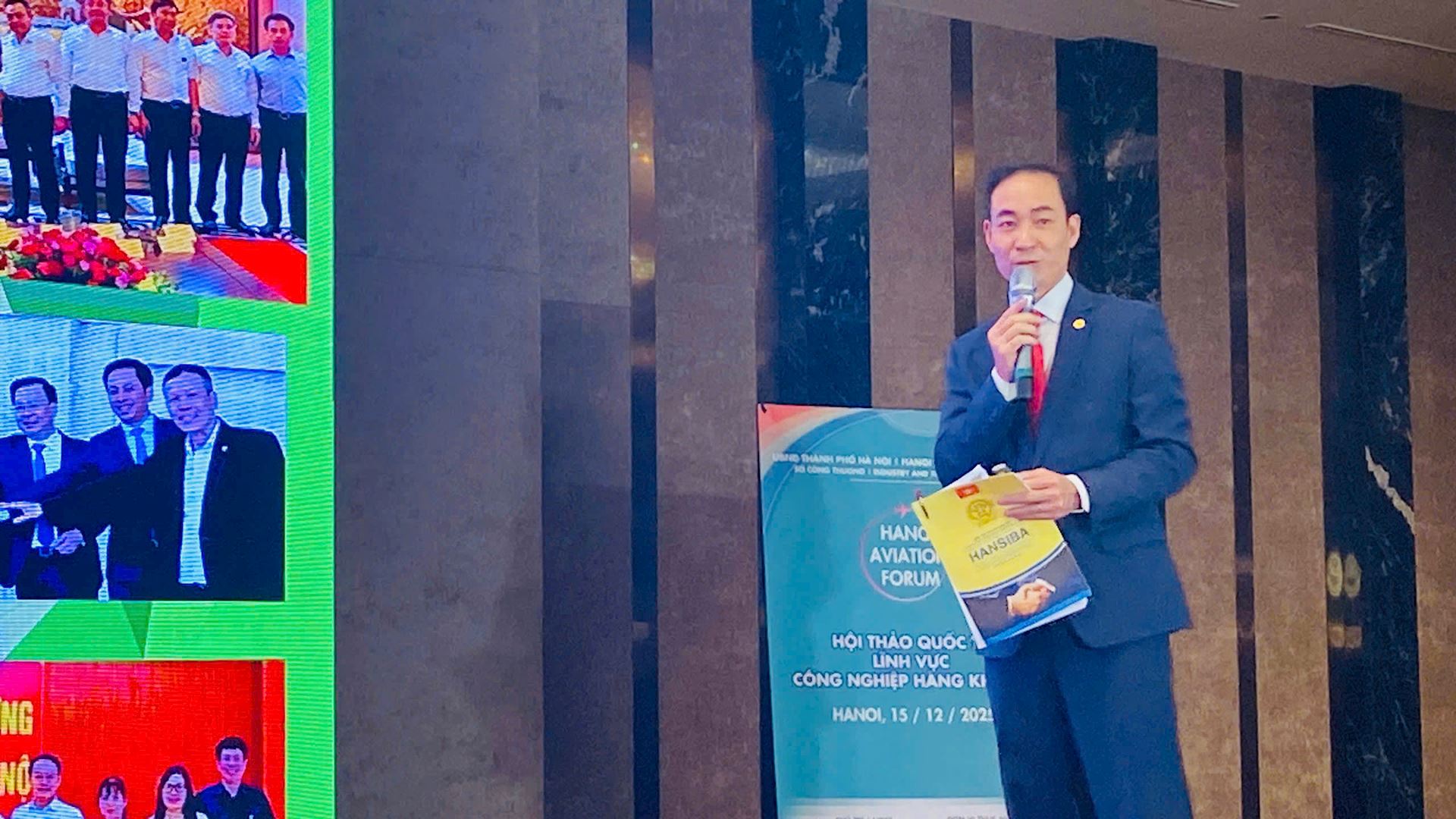
Mr. Nguyen Van – Vice President of the Hanoi Association of Supporting Industries Enterprises (HANSIBA). Photo: Khac Kien
Mr. Nguyen Van, Vice Chairman of the Hanoi Association of Supporting Industries Businesses (HANSIBA), stated that in the context of the global aviation industry recovering after the Covid-19 pandemic, while being profoundly impacted by green transformation, digital transformation, and supply chain restructuring, the demand for new, stable, and sustainable manufacturing destinations is increasing rapidly. Southeast Asia, including Vietnam, is emerging as a highly potential region thanks to its strategic geopolitical location, young workforce, competitive costs, and stable socio-political environment.
“The creation of an environment that fosters high-end, sustainable network development, applying high-knowledge technologies, cleaner production, and air transport closely connected to consumers, will contribute to enhancing Vietnam’s image and position as a key and important player in the regional and global aviation production, supply, and sustainable consumption networks,” Mr. Van emphasized.
He added that the aviation industry offers significant potential and ample room for development, thereby making a positive contribution to shaping Vietnam’s socio-economic development orientation in a new era, and concretely supporting Hanoi’s industrial growth target of 9.5% during the capital’s period of strong transformation.
Currently, the global aviation industry is of enormous value, with global revenues reaching approximately USD 1 trillion in 2024 and 2025, contributing USD 3.5 trillion to global GDP prior to the pandemic, supporting millions of jobs, boosting international trade and tourism, and undergoing a revolution driven by artificial intelligence and sustainability. The industry extends beyond passenger transport to include logistics and maintenance, with strong growth potential fueled by the recovery of travel demand and broader socio-economic factors.
The global civil aircraft manufacturing industry is expected to reach nearly USD 1 trillion in value in 2025, driven primarily by demand for new aircraft, tourism recovery, and the shift of manufacturing activities toward the Asia-Pacific region. Boeing and Airbus continue to lead the market, while Vietnamese enterprises have opportunities to participate more deeply in the components supply chain, especially as green and sustainable technologies gain prominence.
Market share in the aviation industry is gradually shifting toward the Asia-Pacific region, creating opportunities for countries like Vietnam to integrate into global supply chains. Vietnam has the potential to engage more deeply in the production of parts and components as demand for aircraft and maintenance services increases.
At present, Vietnam remains at an early stage of development, focusing mainly on services, operations, and logistics, while lacking supporting industries such as design and manufacturing. Infrastructure has not kept pace with growth, and human resources (engineers and specialists) remain limited, leading to high dependency and low competitiveness, despite strong potential stemming from geographic advantages, a rapidly expanding market, and supportive policies aimed at forming a domestic ecosystem and integrating into global supply chains.
“Supporting industries remain weak, mainly producing simple, low-value components, lacking in-depth research and design capabilities; domestic supply capacity meets only about 10% of demand. Airport infrastructure is often overloaded (Tan Son Nhat, Noi Bai), while air logistics facilities and warehousing remain underdeveloped and unable to keep pace with service growth. Human resources are insufficient, including pilots, technicians, and digital technology experts; training quality is uneven. Enterprises lack strategic linkages, a strong sense of community, and have limited R&D capacity,” Mr. Nguyen Van frankly pointed out.
However, the market still offers significant growth potential, with double-digit growth in transport demand and rising logistics needs. Vietnam’s strategic location in the Asia-Pacific region is a major advantage. The Government has also issued orientations to support aviation industry development and the formation of a domestic ecosystem, along with opportunities to join global supply chains as airlines and manufacturers seek new partners.
To develop Vietnam’s high-potential aviation industry, Mr. Nguyen Van stressed the need to focus on developing supporting industry enterprises; building ecosystems; training internationally standardized, high-quality human resources; attracting technology transfer; and fostering strategic partnerships with major global players (Airbus, Boeing, Embraer). Priority should be given to manufacturing complex components and materials (such as alloys and composites) that meet stringent certifications (AS9100), upgrading domestic capabilities, and moving toward deeper participation in the global value chain rather than isolated processing activities.
In particular, continued attention should be given to promoting and creating policy mechanisms to form next-generation high-tech industrial complexes (Technoparks) within operational industrial parks. Focus should be placed on established industrial zones where domestic and foreign-invested enterprises have already built factories and production complexes related to supporting industries, high technology, and aviation with proven development potential, such as Hoa Lac Hi-Tech Park and the South Hanoi Supporting Industrial Park (HANSSIP). This will enable enterprises to closely align with and effectively implement supporting industry development programs issued by the Hanoi People’s Committee, as well as the capital’s aviation-related industrial development orientations in the new development phase.
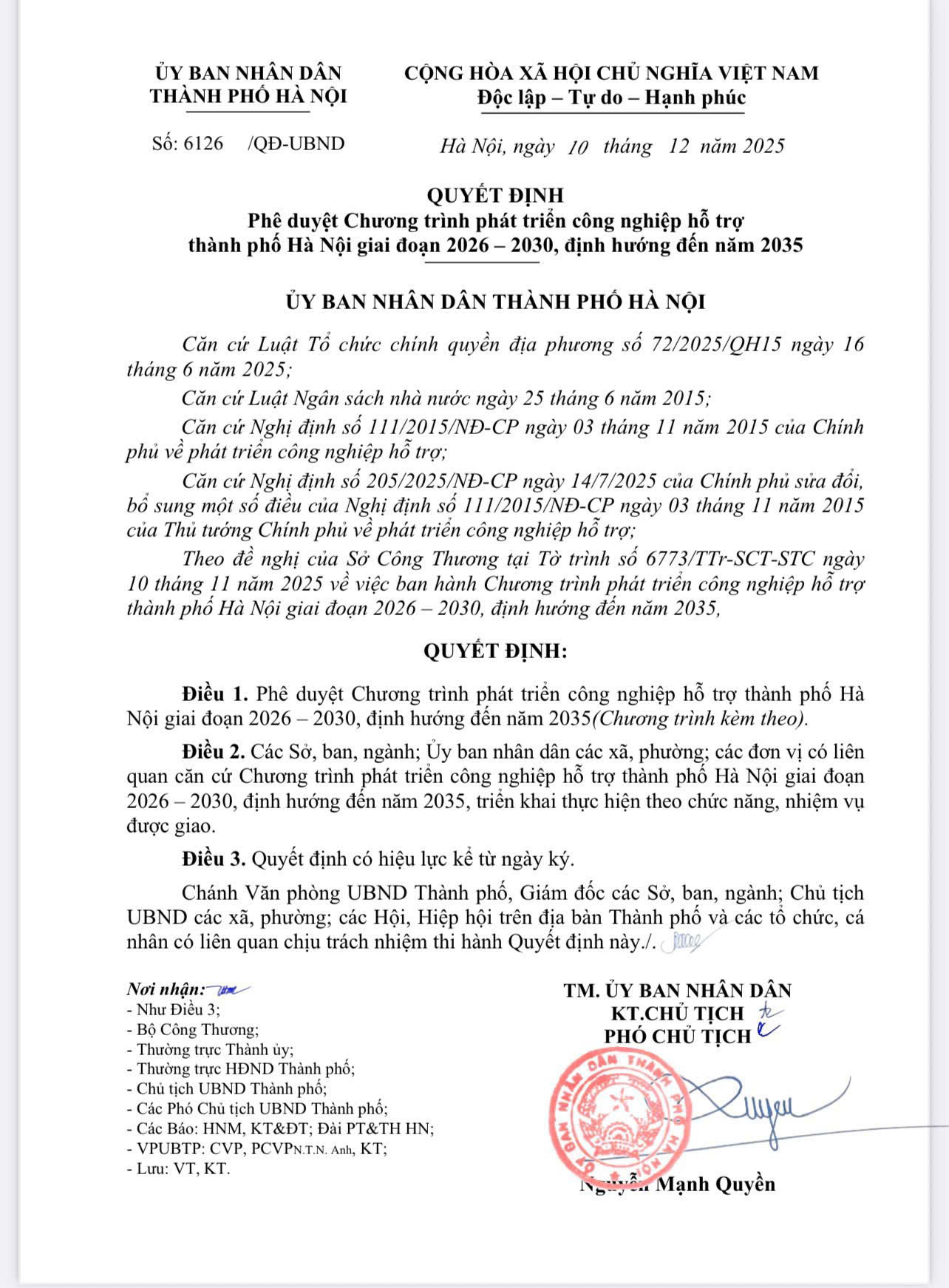
Decision approving the Supporting Industry Development Program of Hanoi for the 2026–2030 period, with orientation toward 2035, issued by the Hanoi People’s Committee on December 10, 2025.